Viper Bite in Portuguese Territory: A Clinical Case
DOI:
https://doi.org/10.60591/crspmi.378Keywords:
Antivenins/therapeutic use, Snake Bites/therapy, Viper Venoms, ViperidaeAbstract
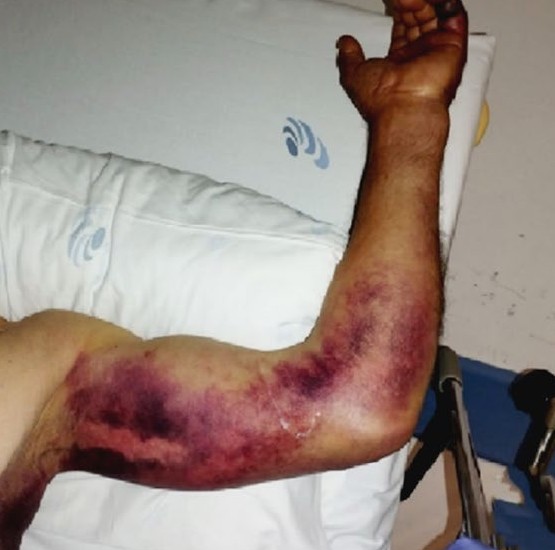
Snakebites in Portugal are rare, but potentially serious. We report a case of viper bite with local and systemic involvement with criteria for administration of antivenom. The poisoning was attributed to Vipera latastei, with a hemo- and cytotoxic poison, causing tissue necrosis, coagulopathy and acute kidney injury. This case highlights the importance of early diagnosis, a multidisciplinary approach and the appropriate use of antivenom.
Downloads
References
1. Paolino G, Di Nicola MR, Pontara A, Didona D, Moliterni E, Mercuri SR, et al. Vipera snakebite in Europe: a systematic review of a neglected disease. J Eur Acad Dermatol Venereol. 2020;34:2247-60. doi: 10.1111/jdv.16722.
2. Instituto Nacional de Emergência Médica (INEM). Dados estatísticos – Centro de Informação Antivenenos. Lisboa: Instituto Nacional de Emergência Médica; 2023. [consultado abril 2024] Disponível em: https://www.inem.pt/wp-content/uploads/2024/03/CIAV-ESTATISTICA_2023.pdf
3. Valdoleiros SR, Gonçalves IC, Silva C, Guerra D, Silva LA, Martínez-Freiría F, et al. Animais venenosos em território português: abordagem clínica de picadas e mordeduras. Acta Med Port. 2021;34:784-95. Portuguese. doi: 10.20344/amp.15589.
4. Díez E, Peña M, Cano P, Gamo A.Tratamiento de la mordedura por víbora en España. SEMERGEN. 2014;42:10.1016/j.semerg.2014.08.005. doi:10.1016/j.semerg.2014.08.005
5. Loureiro A, Ferrand de Almeida N, Carretero MA, Paulo OS. Atlas dos anfíbios e répteis de Portugal. Lisboa: Instituto da Conservação da Natureza e da Biodiversidade; 2008.
6. World Health Organization. Guidelines for the management of snakebites. 2nd ed. Geneve: WHO Regional Office for South-East Asia; 2016.
7. Gutiérrez JM, Calvete JJ, Habib AG, Harrison RA, Williams DJ, Warrell DA. Snakebite envenoming. Nat Rev Dis Primers. 2017;3:17063. doi: 10.1038/nrdp.2017.63. Erratum in: Nat Rev Dis Primers. 2017;3:17079. doi: 10.1038/nrdp.2017.79.
8. Audebert F, Sorkine M, Bon C. Envenoming by viper bites in France: clinical gradation and biological quantification by ELISA. Toxicon. 1992;30:599-609. doi: 10.1016/0041-0101(92)90854-x.
9. Boels D, Hamel JF, Bretaudeau Deguigne M, Harry P. European viper envenomings: Assessment of Viperfav™ and other symptomatic treatments. Clin Toxicol. 2012;50:189-96. doi: 10.3109/15563650.2012.660695.
10. Boels D, Hamel JF, Le Roux G, Labadie M, Paret N, Delcourt N, et al. Snake bites by European vipers in Mainland France in 2017-2018: comparison of two antivenoms Viperfav® and Viperatab®. Clin Toxicol. 2020;58:1050-57. doi: 10.1080/15563650.2020.1726377.
11. Casewell NR, Al-Abdulla I, Smith D, Coxon R, Landon J. Immunological cross-reactivity and neutralisation of European viper venoms with the monospecific Vipera berus antivenom ViperaTAb. Toxins. 2014;6:2471-82. doi: 10.3390/toxins6082471.
Downloads
Published
How to Cite
Issue
Section
Categories
License
Copyright (c) 2025 Rita Domingos, Ana Sara Monteiro, Paula Nogueira, Patrício Marinho, João Nunes

This work is licensed under a Creative Commons Attribution 4.0 International License.