Complex Intrahepatic Vascular Shunts in Hereditary Hemorrhagic Telangiectasia: From Portal Hypertension to High-Output Cardiac Failure
DOI:
https://doi.org/10.60591/crspmi.557Keywords:
Hypertension, Portal, Liver Diseases, Telangiectasia, Hereditary HemorrhagicAbstract
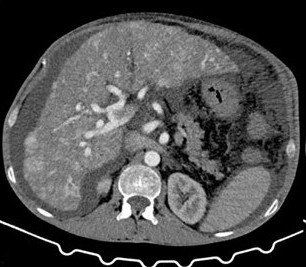
Hereditary haemorrhagic telangiectasia (HHT) is a rare autosomal dominant vascular disorder that may involve the liver through complex intrahepatic vascular malformations. We report the case of a 64-year-old man with genetically confirmed HHT type 2 who developed symptomatic hepatic vascular shunts, complicated by clinically significant portal hypertension, recurrent gastrointestinal bleeding, and high-output cardiac failure. The patient was treated with supportive measures and antiangiogenic therapy with bevacizumab, resulting in transient clinical and hemodynamic improvement. However, disease progression was marked by refractory ascites, variceal bleeding, severe malnutrition, sarcopenia, and progressive frailty, ultimately limiting therapeutic options, including liver transplantation. This case illustrates the heterogeneous clinical expression of hepatic involvement in HHT, the potential benefits and limitations of bevacizumab therapy, and highlights the impact of frailty and nutritional deterioration on clinical decision-making and prognosis.
Downloads
References
1. Faughnan ME, Mager JJ, Hetts SW, Palda VA, Lang-Robertson K, Buscarini E, et al. Second International Guidelines for the Diagnosis and Management of Hereditary Hemorrhagic Telangiectasia. Ann Intern Med. 2020;173:989-1001. doi: 10.7326/L21-0068.
2. Shovlin CL, Guttmacher AE, Buscarini E, Faughnan ME, Hyland RH, Westermann CJ, et al. Diagnostic criteria for hereditary hemorrhagic telangiectasia (Rendu-Osler-Weber syndrome). Am J Med Genet. 2000;91:66-7.
3. Vilgrain V, Paradis V, Van Wettere M, Valla D, Ronot M, Rautou PE. Benign and malignant hepatocellular lesions in patients with vascular liver diseases. Abdom Radiol. 2018;43:1968-77. doi: 10.1007/s00261-018-1502-7.
4. Letteboer TG, Mager JJ, Snijder RJ, Koeleman BP, Lindhout D, Ploos van Amstel JK, et al. Genotype-phenotype relationship in hereditary haemorrhagic telangiectasia. J Med Genet. 2006;43:371-7.
5. Garcia-Tsao G. Liver involvement in hereditary hemorrhagic telangiectasia (HHT). J Hepatol. 2007;46:499-507.
6. Dupuis-Girod S, Riviere S, Lavigne C, Fargeton AE, Gilbert-Dussardier B, Grobost V, et al. Efficacy and safety of intravenous bevacizumab on severe bleeding associated with hemorrhagic hereditary telangiectasia: A national, randomized multicenter trial. J Intern Med. 2023;294:761-74. doi: 10.1111/joim.13714.
7. Chavan A, Schumann-Binarsch S, Schmuck B, Oltmer F, Geisthoff U, Hoppe F, et al. Emerging role of bevacizumab in management of patients with symptomatic hepatic involvement in hereditary hemorrhagic telangiectasia. Am J Hematol. 2017;92:E641-E4. doi: 10.1002/ajh.24878.
8. Ielasi L, Tonnini M, Piscaglia F, Serio I. Current guidelines for diagnosis and management of hepatic involvement in hereditary hemorrhagic teleangiectasia. World J Hepatol. 2023;15:675-87. doi: 10.4254/wjh.v15.i5.675.
9. de Franchis R, Bosch J, Garcia-Tsao G, Reiberger T, Ripoll C, VII Faculty. Baveno VII - Renewing consensus in portal hypertension. J Hepatol. 2022;76:959-74. doi: 10.1016/j.jhep.2021.12.022
10. Junquera F, Saperas E, Videla S, Feu F, Vilaseca J, Armengol JR, et al. Long-term efficacy of octreotide in the prevention of recurrent bleeding from gastrointestinal angiodysplasia. Am J Gastroenterol. 2007;102:254-60. doi: 10.1111/j.1572-0241.2007.01053.x.
11. Chavan A, Galanski M, Wagner S, Caselitz M, Schlitt HJ, Gratz KF, et al. Hereditary hemorrhagic telangiectasia: effective protocol for embolization of hepatic vascular malformations--experience in five patients. Radiology. 1998;209:735-9.
12. Dupuis-Girod S, Ginon I, Saurin JC, Marion D, Guillot E, Decullier E, et al. Bevacizumab in patients with hereditary hemorrhagic telangiectasia and severe hepatic vascular malformations and high cardiac output. JAMA. 2012;307:948-55.
13. Thandassery RB, Patel RS, Grewal P. Hereditary hemorrhagic telangiectasia and refractory ascites. ACG Case Rep J. 2020;7:e00458. doi: 10.14309/crj.0000000000000458.
14. Topan MM, Sporea I, Danila M, Popescu A, Ghiuchici AM, Lupusoru R, et al. Impact of sarcopenia on survival and clinical outcomes in patients with liver cirrhosis. Front Nutr. 2021;8:766451. doi: 10.3389/fnut.2021.766451.
15. Cui Y, Zhang M, Guo J, Jin J, Wang H, Wang X. Correlation between sarcopenia and cirrhosis: a meta-analysis. Front Nutr. 2023;10:1342100. doi: 10.3389/fnut.2023.1342100.
16. Lai JC, Sonnenday CJ, Tapper EB, Duarte-Rojo A, Dunn MA, Bernal W, et al. Frailty in liver transplantation: An expert opinion statement from the American Society of Transplantation Liver and Intestinal Community of Practice. Am J Transplant. 2019;19:1896-906. doi: 10.1111/ajt.15392.
17. Riera-Mestre A, Cerda P, Guzman YC, Iriarte A, Torroella A, Mora-Lujan JM, et al. Perioperative complications and long-term follow-up of liver transplantation in hemorrhagic hereditary telangiectasia: report of three cases and systematic review. J Clin Med. 2022;;11:5624. doi: 10.3390/jcm11195624.
18. Felli E, Addeo P, Faitot F, Nappo G, Oncioiu C, Bachellier P. Liver transplantation for hereditary hemorrhagic telangiectasia: a systematic review. HPB. 2017;19:567-72. doi: 10.1016/j.hpb.2017.03.005.
Downloads
Published
How to Cite
Issue
Section
Categories
License
Copyright (c) 2026 Filipe Nery, Diana Valadares, Manuel Teixeira Gomes

This work is licensed under a Creative Commons Attribution 4.0 International License.